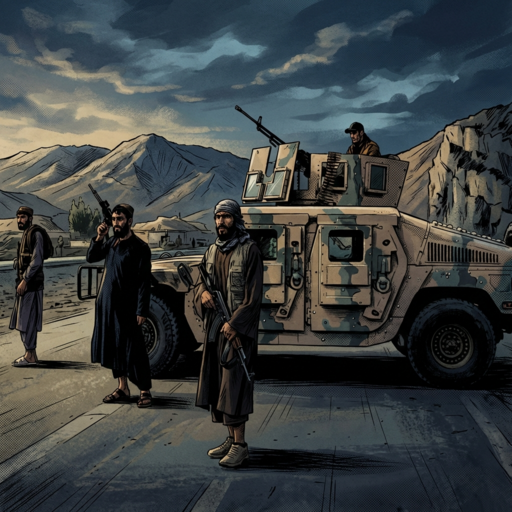
Pakistan Declares 'Open War,' Bombs Kabul and Major Afghan Cities
Pakistan's defense minister declared an 'open war' on Afghanistan's Taliban government, launching air strikes on Kabul and other major cities. The bombings, which continued until dawn, follow months of escalating tit-for-tat clashes, with a border camp for returning Afghans also hit by the fighting.
On February 27, 2026, Pakistan's Defense Minister Khawaja Asif declared an 'open war' with Afghanistan's Taliban government following a series of escalating military actions. The declaration came after Pakistan launched airstrikes on major Afghan cities including Kabul, Kandahar, and Paktia province, targeting Taliban defense sites. These strikes were conducted under Operation 'Ghazab Lil Haq' and continued until dawn, with AFP journalists reporting jets overhead and explosions in both Kabul and Kandahar. The bombings represent a significant escalation in the ongoing border conflict between the two nations.
The conflict began with initial Pakistani strikes on February 21, 2026, when Pakistan Air Force targeted militant camps in Nangarhar, Paktika, and Khost provinces, focusing on Pakistani Taliban (TTP) and ISIS-K sites linked to recent attacks in Pakistan. UNAMA reported infrastructure damage but no civilian casualties from these initial strikes. Hostilities continued from February 24-26 with both sides exchanging fire along the border, culminating in what Afghanistan described as a 'retaliatory operation' on February 26 at 20:00 local time, which they claimed killed numerous Pakistani soldiers and captured others - claims denied by Pakistan.

Key figures involved include Pakistan's Defense Minister Khawaja Asif, who made the 'open war' declaration, and Taliban spokesman Zabihullah Mujahid, who initially reported no casualties from the latest strikes. Both sides have presented conflicting casualty claims, with Afghanistan claiming 55 Pakistani soldiers killed and several captured, while Pakistan claims 133+ Afghan fighters killed and 200+ wounded. No independent verification of these casualty figures exists, and the actual numbers remain disputed.
The broader context reveals deteriorating relations since 2024 clashes, including Pakistani strikes in December 2024 and October 2024 fighting that killed over 70 people. Border crossings are largely closed despite a failed Qatar-Turkey mediated ceasefire. Pakistan accuses the Taliban of harboring TTP and other militants, while Kabul denies these allegations. The conflict marks the third round of Pakistani airstrikes on Afghan territory in less than two years, indicating a pattern of escalating violence along the disputed border region.
Consequences of this open war declaration include heightened regional instability, potential humanitarian crises in border areas, and strained diplomatic relations in South Asia. A border camp for returning Afghans was reportedly hit by the fighting, raising concerns about civilian displacement and refugee safety. The situation remains volatile with no immediate diplomatic resolution in sight, and international observers are monitoring for potential spillover effects in the region.
Join the discussion
What do you think? Drop your thoughts below.